
TV Wall Mounting in Westminster
TV Mounting Mark Westminster covers everyday TV wall mounting across Westminster — living rooms, bedrooms and family rooms in single-story tract houses, townhomes and apartments — where a local installer finds the wood behind the wall, sets a fixed or tilting bracket into it and tidies the cords.

Bookings aren't open yet. Leave your name and number; your message is recorded, and you'll get one message when a local installer is available.
 Illustration
From box to wall, one step at a time
Every mounting visit follows the same order, and the order is what keeps the screen on the wall.
- Weigh the TV. Its weight, VESA hole pattern and width are noted, and the bracket has to be rated for at least 1.5 times the weight.
- Find the wood. A stud finder gives a first guess; a thin probe hole where the plate will sit gives the proof.
- Outline the screen. Painter's tape shows the picture size on the wall before any hole is drilled.
- Fasten the plate. Pilot holes, lag bolts into the studs and a level on the plate.
- Hang the set. The TV hooks on and the safety screws go in.
What the numbers show
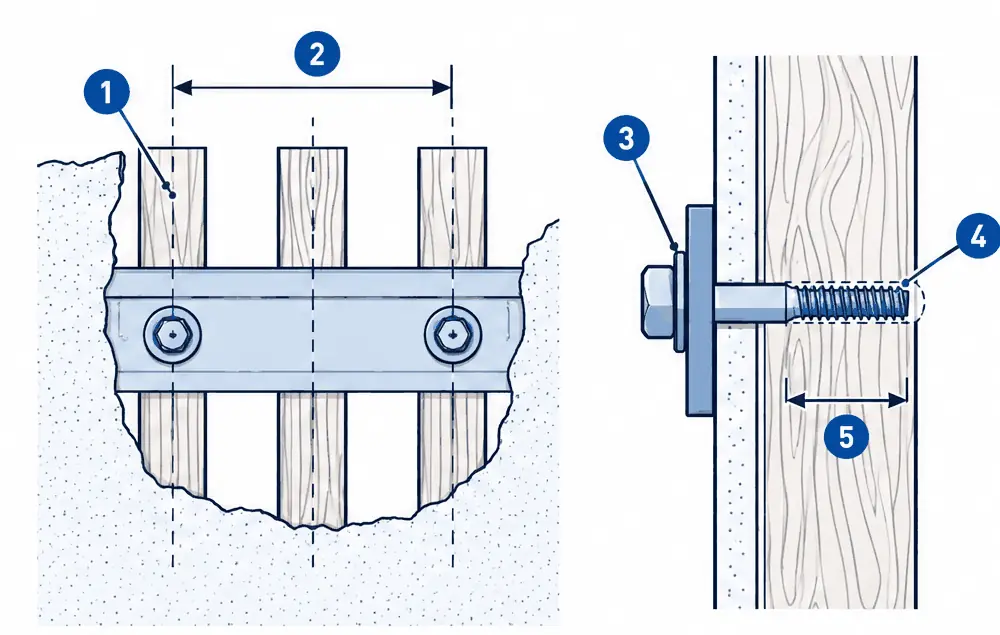
- Stud center line The bolt is aimed at the middle of the stud, where the wood is thickest.
- Stud spacing The line runs across two stud bays, from the first stud to the third; with studs usually about 16 inches apart, a wide plate bolted into the outer two studs gets two solid fixing points about 32 inches apart.
- Washer and head The washer spreads the clamp load over the plate.
- Threads in the wood The threads bite into the stud and end inside it.
- Depth in the stud The bolt goes deep enough into the wood to hold the load, never only into the surface.
Flat against the wall, or angled down
| Mount | Suits | Trade-off |
|---|---|---|
| Fixed | A screen at eye level, facing the seats | Closest to the wall, no angle |
| Tilting | A screen that has to sit above eye level | A little further out, tips the picture down |
In a Westminster tract house with a standard ceiling, a fixed mount is the first choice for a screen at eye level. A tilting mount earns its place above a console or opposite a bright window, where a few degrees keep the glass from throwing the light back.
What the numbers show
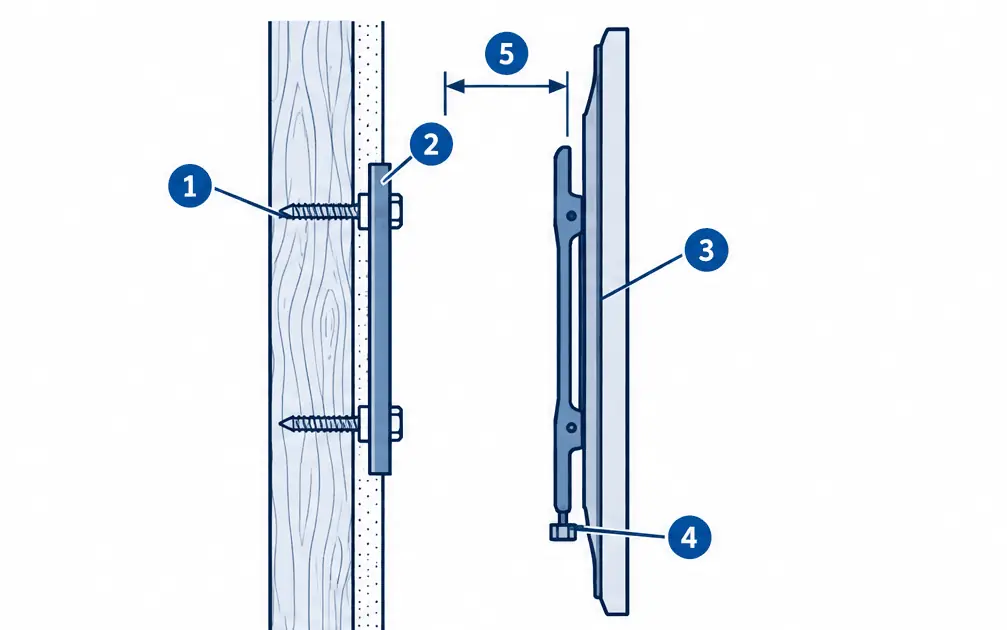
- Lag bolt in the stud Each bolt passes through the plate and the wall surface and ends inside the stud, so the TV hangs from the framing.
- Rails on the plate An upper and a lower rail take the brackets; the plate is leveled before the last bolt is tightened.
- Brackets on the TV Two brackets screw into the mounting holes on the back of the set and hook over the rails; the mount is rated for at least 1.5 times the weight.
- Locking screw A small screw at the foot of a bracket keeps a bump from lifting the TV off the rails.
- Gap to the wall The gap leaves room for plugs; a fixed mount cannot be adjusted once the TV is hung.
Studs that do not line up with the picture
Studs usually sit about 16 inches apart, but a room that has been remodeled seldom keeps the pattern from corner to corner. A plate that spans two studs while the picture stays centered is the first answer. When the layout will not allow it, a backer board screwed across several studs gives the plate a solid face.
- Wide plate reaches two studs.
- Backer board spreads the load over three or more.
- Strap toggles are a last resort for a light set, never a substitute for wood under a large one.
What the numbers show
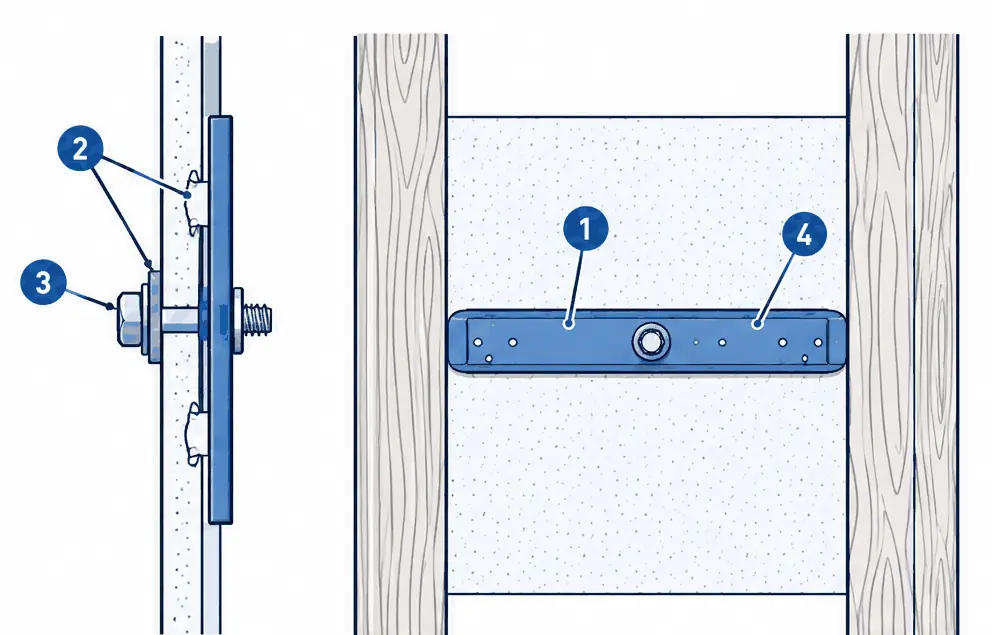
- Steel channel The channel lies flat behind the wall surface and is longer than the hole is wide, so it cannot pull through.
- Plastic straps The straps hold the channel in place while it is tightened, then snap off flush.
- Machine bolt The bolt threads into the channel from the room side and clamps the plate.
- Span across the board The channel spreads the load across the wall surface, which is much weaker than wood.
Dressing the cords
The simplest finish ties the cords in a short bundle behind the set, with the outlet low and close. A slim surface raceway painted the color of the wall tidies the run without opening the wall. Hiding the wires inside the wall is a separate job with its own price and its own rules: a standard power cord never goes in a wall, only an in-wall rated kit does, and a new outlet is work for an electrician.
TV Wall Mounting — common questions
How much does a basic TV wall mount cost in Westminster?
Expect roughly $92–$132 for a 32–49 inch set and $112–$162 for 50–65 inches on drywall over wood studs in 2026. Bigger TVs and harder walls move the figure up.
Does the TV need a special bracket?
It needs one rated for the weight of the set, with a hole pattern that matches the back of the TV. A bracket the household already owns is checked against both before it goes up.
Availability & price range
TV Wall Mounting: check availability and price range
Bookings aren't open yet — answer a few quick questions about the TV and the wall and get a typical Westminster price range right here. Typical Westminster prices for one TV, labor only unless an option says otherwise. This is a market estimate, not a quote.